Decoding the Principles of Emergence and Resiliency in Biological Collective Systems
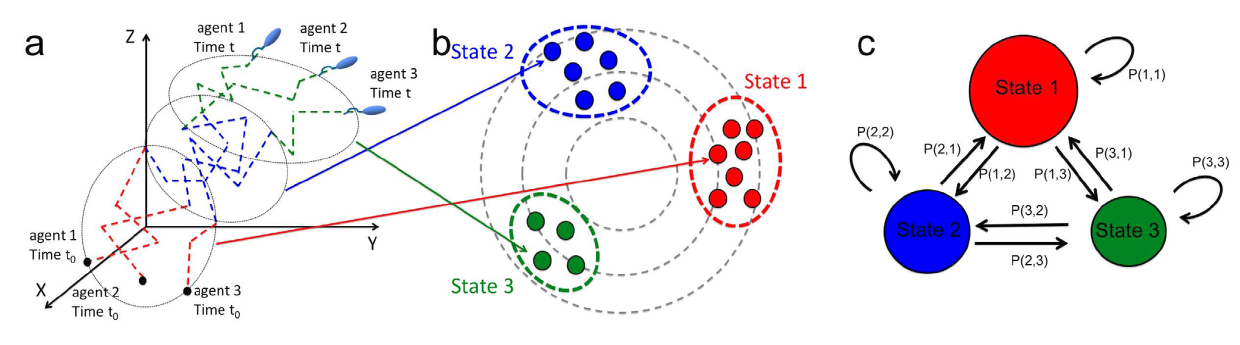 |
Despite significant research on decoding the principles of collective behavior and autonomy in biological systems, we lack a unified theory and a quantifiable framework for measuring their emergence, self-organization, robustness, resiliency, and complexity. Towards this end, we formulated a statistical physics inspired framework for describing the collective system dynamics of biological swarms through a novel free-energy landscape encoding the spatio-temporal states of the swarm motion and its interactions. This free-energy formalism supports the definition of a performance envelope for complex collective systems consisting of formulas for quantifying the missing information, emergence, self-organization, and complexity metrics. These metrics enable a categorization of the degree of complexity and intelligence exhibited by a complex system. This algorithmic perspective applied to studying biological systems can be integrated into new computer-aided design frameworks for the engineering of collective motions of unmanned aerial vehicles (UAVs) and autonomous vehicles to achieve specific degrees of emergence, self-organization, robustness, and complexity. Moreover, this formalism opens new more tractable venues for controlling complex systems by shifting the focus from the agent / state space representation to a reduced order encapsulated in the free-energy landscape.